



Looking into getting your Bat Licence? If you are trying to progress your career in ecology, gaining a bat licence can be an important professional milestone.
But what happens if your employer will not pay for training, cannot provide enough survey experience or simply does not have anyone available to supervise you?
The short answer is that you can still work towards a bat licence without employer support, but it will usually take more time and you will need to be deliberate about how you gain the experience you need.
One of the biggest misunderstandings is that getting a bat licence is mainly about completing a training course.
It isn’t.
Courses can help you develop knowledge and practical skills, but the real challenge is usually gaining enough supervised experience to demonstrate competence.
That means the biggest cost is often not money. It is time.
And if your employer is not supporting your development, much of that time may need to come from evenings, weekends or voluntary survey work.
What Experience Do You Need for a Bat Licence?
Bat licensing is based on demonstrating that you have the appropriate knowledge, skills and practical experience for the activities covered by the licence you are applying for.
That means attending a course alone will not normally be enough.
You need opportunities to take part in real survey work and develop practical competence under the guidance of experienced ecologists or licence holders.
Depending on the licence and your level of experience, this could include exposure to activities such as:
- bat activity surveys
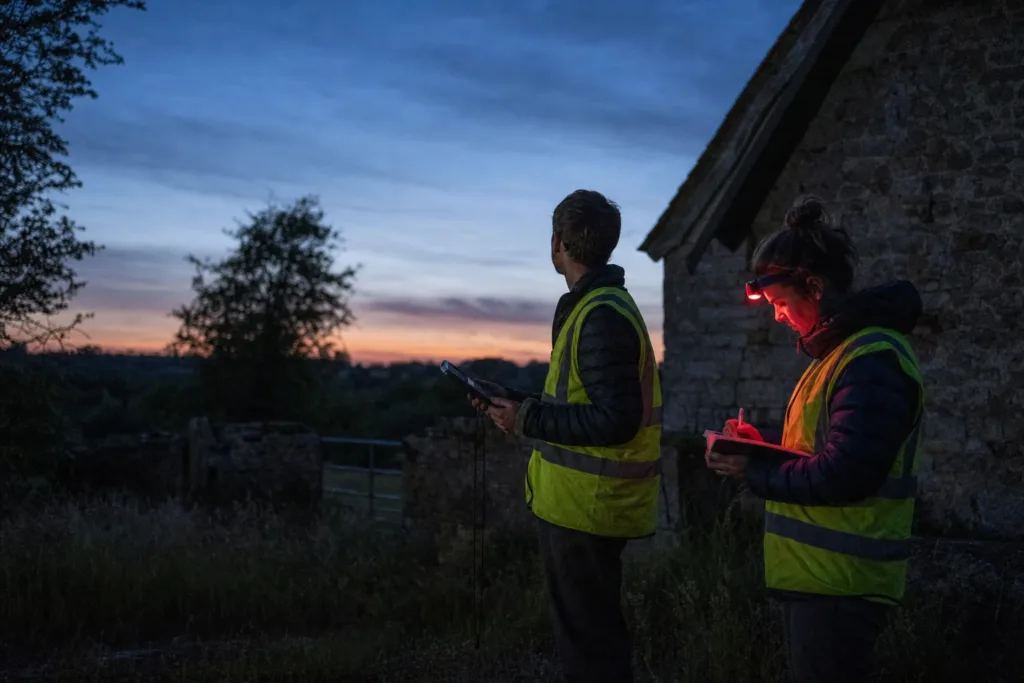
- emergence and re-entry surveys
- roost assessments
- species identification
- use of bat detectors
- interpreting bat behaviour
- understanding survey limitations
- recording survey findings accurately
- working safely and professionally in the field
The important point is that competence develops through repeated practical experience, not simply through classroom learning.
Can You Get Bat Survey Experience Without Your Employer?
Yes.
For many ecologists, one of the most accessible routes is through local bat groups, conservation organisations and voluntary survey projects.
Local bat groups frequently undertake surveys, monitoring and conservation work and can provide valuable opportunities to work alongside experienced people.
That experience can help you:
- build practical survey hours
- improve species identification
- gain confidence using survey equipment
- understand bat behaviour
- meet experienced licence holders
- develop relationships within the profession
- build evidence of your practical experience
For someone whose employer cannot provide sufficient survey opportunities, volunteering can become an important part of their professional development.
The trade-off is fairly obvious.
Instead of your development happening during your paid working week, you may need to give up evenings or weekends.
But that can still be considerably more valuable than simply waiting for your employer to provide an opportunity that may never arrive.
Keep Your Own Record of Bat Survey Experience
This is something I would encourage every early-career ecologist to do from the beginning.
Do not rely entirely on your employer to maintain evidence of your experience.
Keep your own detailed record of the surveys, training and practical activities you have completed.
That might include:
- date
- survey type
- location or project reference
- species encountered
- techniques used
- equipment used
- your role during the survey
- who supervised you
- skills demonstrated
- learning points
The more organised you are, the easier it becomes to demonstrate how your experience has developed.
It also matters if you change employer.
Your professional development belongs to you.
If you spend two years building experience and then move to another consultancy, you do not want to start trying to reconstruct everything from memory.
Keeping accurate records from day one makes the process considerably easier.
What Should You Ask an Employer About Bat Licensing?
If gaining a bat licence is important to your career plans, ask about it before accepting a role.
Do not simply ask:
“Do you support training?”
Almost every employer can say yes to that.
Instead, ask more specific questions.
For example:
Who in the ecology team currently holds bat licences?
This matters because experienced licence holders are likely to be the people supervising your development.
If nobody within the business holds the relevant licence, the company may have limited ability to provide the experience you need.
You should also ask:
Will I have opportunities to work on bat surveys regularly?
A consultancy may undertake bat work, but that does not necessarily mean every junior ecologist gets meaningful exposure to it.
Another useful question is:
Would licence development form part of my normal workload and development plan?
This is where there can be a significant difference between employers.
There is a big distinction between:
“We support people who want to develop.”
and:
“We will actively give you supervised survey experience and include licence development within your workload.”
Those are not the same thing.
Does Your Employer Need a Bat Licence Holder?
If you want structured support towards a licence, having experienced bat specialists or licence holders within the team can make a significant difference.
They may be able to:
- supervise practical work
- provide feedback
- expose you to different survey situations
- help identify gaps in your experience
- support your professional development
A company without anyone able to provide that supervision may still offer valuable ecology experience, but your route towards a bat licence could be slower.
That is why asking about the structure of the ecology team before accepting a job can be worthwhile.
What If Your Employer Will Not Support You?
If the answer continues to be no, treat that as useful career information rather than a dead end.
Your employer does not necessarily have to provide every part of your professional development.
You may decide to continue gaining experience independently through voluntary work and external opportunities.
Equally, there may come a point where you decide that another employer would offer better opportunities for your long-term career.
That is not unusual.
Plenty of ecologists gain their first substantial field experience with one consultancy and then move elsewhere to access better training, specialist work or licensing opportunities.
Changing employer because you want stronger professional development can be a perfectly reasonable career decision.
Do Not Chase the Licence at the Expense of Experience
There is also a danger of becoming too focused on obtaining the licence itself.
The licence should be the result of developing genuine competence.
The aim is not simply to add another line to your CV.
The more varied your experience, the better prepared you are likely to be when you eventually take on greater responsibility.
That means gaining exposure to different sites, survey conditions, species, project types and experienced ecologists can be just as important as reaching a particular number of survey hours.
Think About Your Wider Ecology Career Too
Bat licensing can be valuable, particularly if you want to specialise in protected species work.
But it is still only one part of becoming a strong ecological consultant.
Early-career ecologists should also continue developing areas such as:
- Preliminary Ecological Appraisals
- report writing
- GIS
- planning and legislation
- client communication
- habitat assessment
- Biodiversity Net Gain
- project organisation
- commercial awareness
A good ecologist is rarely defined by one licence alone.
The strongest early-career development usually comes from combining technical knowledge, practical survey experience and an understanding of how consultancy projects actually work.
The Bottom Line
You do not necessarily need your employer to fund every part of your journey towards a bat licence.
What you do need is access to relevant experience, appropriate supervision and a clear record of your development.
If your employer can provide that within your role, excellent.
If they cannot, consider voluntary survey work, local bat groups and other opportunities to build experience outside work.
And if professional development is consistently unavailable, it may eventually be worth looking for an employer that can support the direction you want your career to take.
The important thing is not to sit still waiting for somebody else to develop your career for you.
Build the experience, keep good records, seek out good supervision and make deliberate decisions about where you want your ecology career to go.
Useful next steps
If you are developing your career in ecology, take a look at our Ecology Careers Hub for practical guidance on gaining experience, developing consultancy skills and progressing within the profession.
You can also explore Ecology Ready, our live programme for aspiring and early-career ecologists who want to better understand how ecological consultancy works in practice.